
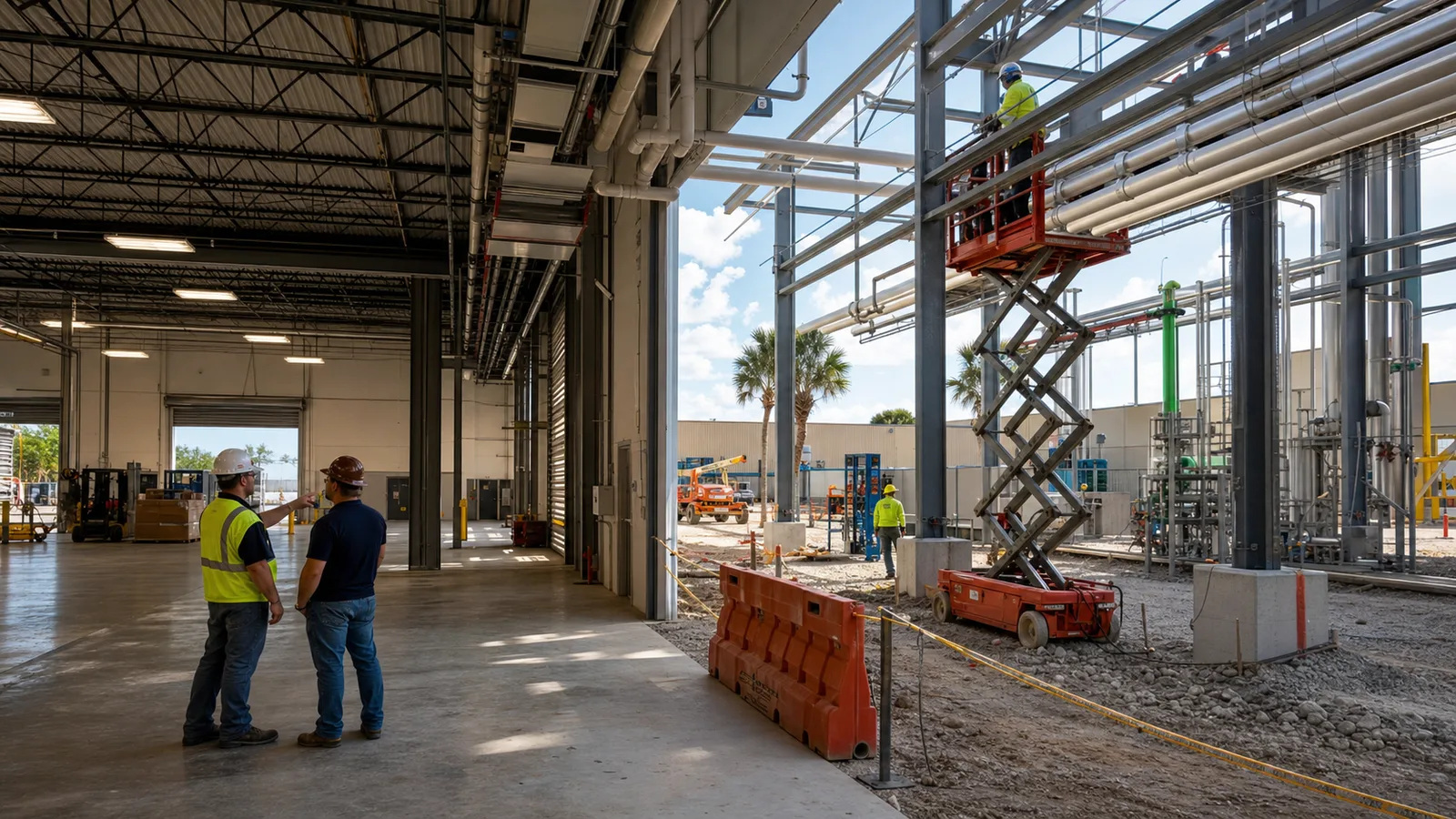
Process industrial retrofits in Florida carry a challenge that new construction does not: the plant is usually still running. Adding a line, replacing equipment, or expanding a building while production continues means coordinating construction around live operations, tracking every change through a formal process, and tying new utilities into systems that cannot simply be shut off. This guide explains how to phase work safely, manage change correctly, handle utility tie-ins, and account for Florida flood, wind, and site constraints.
Red Fox Construction brings 19 years of Florida commercial construction experience to retrofits and expansions across Central Florida, from Orlando to Tampa and surrounding areas. Whether the goal is a remodel, a whole building conversion, or a tenant alteration, the principles below pair construction discipline with recognized process safety guidance so the work protects both the schedule and the people on site.
What makes a process retrofit harder than new construction?
A process retrofit is harder because work happens around active operations, existing conditions are often undocumented, and every change can affect a system that is still in use. New construction starts with a clean site and frozen design. A retrofit must protect production, verify what is really there, and manage change carefully, which adds layers of planning and risk control.
On a new build, the team controls the entire site and sequence. On a retrofit, the operating plant sets the rules. Crews work in occupied space, near energized equipment and live process lines, often on a schedule built around production windows. The existing building may not match its drawings, so the team has to verify field conditions before committing to a design. And because the plant keeps running, a mistake can interrupt production or create a hazard for people who are still working.
These realities make planning even more important than on a new build. Owners weighing an expansion against a relocation can review how Red Fox handles process industrial construction and how existing-condition work shapes the approach.
How should construction be phased around active operations?
Construction should be phased so each stage protects production, isolates the work area, and limits the time any system is offline. Phasing breaks a retrofit into controlled steps tied to production windows and shutdowns, with clear barriers between construction and operations. The goal is steady progress without exposing operating staff to construction hazards or stopping the plant unexpectedly.
Good phasing starts with the operating calendar. The team identifies planned shutdowns and turnarounds where the most disruptive work can happen, then sequences everything else around continued production. Physical separation between the construction zone and the live plant protects both crews and operators. Utility cutovers and tie-ins are scheduled into the windows where the affected system can safely go offline. A workable phasing plan usually follows a clear order:
- Map the production schedule and identify shutdown or turnaround windows for disruptive work.
- Verify existing field conditions so the design matches reality before work begins.
- Isolate the construction area from active operations with barriers and access control.
- Sequence utility tie-ins and cutovers into windows where systems can safely go offline.
- Stage equipment and materials to limit congestion in occupied space.
- Plan a controlled startup and pre-startup review for each completed phase.
The OSHA guidance supports this discipline. It notes that for existing processes shut down for turnaround or modification, any change other than replacement in kind must go through management of change, and that documentation and training may need updating before startup. Phasing gives those steps the time they need. Red Fox applies the same sequencing logic across its industrial construction projects.
Why is management of change central to a retrofit?
Management of change is central because a retrofit is, by definition, a series of changes to equipment, procedures, or operating conditions. The OSHA guidance defines change as any modification other than replacement in kind and requires that changes be identified and reviewed before implementation. Skipping that review is how retrofits introduce hidden hazards.
The OSHA process safety management guidelines treat management of change as a formal step, not a formality. They describe change as covering modifications to equipment, procedures, raw materials, and processing conditions, and they list the kinds of changes that qualify, from new equipment and altered piping arrangements to revised alarms and interlocks. A typical change review documents the purpose, the technical basis, the safety and health considerations, the updates needed to procedures and diagrams, and the required approvals.
The guidance also warns about temporary changes, noting they have caused catastrophes and tend to become permanent without controls, so a time limit must be set and monitored. For a retrofit, this means every temporary tie-in, bypass, or scaffold-supported condition needs tracking and a plan to return the system to its designed state. A builder who works inside the owner’s change process keeps construction aligned with safety, which the Red Fox project team coordinates with your operations staff.
How should utility tie-ins be planned during a retrofit?
Utility tie-ins should be planned around verified existing capacity, scheduled into safe shutdown windows, and documented so operators know exactly what changed. Connecting new equipment to live electrical, water, gas, or compressed air systems is among the riskiest parts of a retrofit, so each tie-in needs its own plan, isolation steps, and verification.
Tie-ins are where new and old meet, and they demand care. The first question is whether the existing service can carry the added load. As on a new build, underestimating demand forces an unplanned upgrade, but on a retrofit it can also overload a system that other production depends on. Once capacity is confirmed, each tie-in needs a sequence: isolate the system safely, make the connection, test it, and bring it back online during a window that does not interrupt critical production.
Documentation closes the loop. The OSHA guidance stresses keeping diagrams current and notes that piping and instrumentation diagrams must be updated when the process changes during shutdown. After a tie-in, operators need accurate drawings and updated procedures so they can run and maintain the modified system safely. Red Fox builds this documentation discipline into its Florida commercial construction work, led by Principal J.R. Horan.
How do Florida flood, wind, and site constraints affect expansions?
Florida flood, wind, and site constraints affect expansions because new additions must meet current code even when the existing building predates it. Flood elevation rules, wind design, and limited site space can all shape where and how an expansion is built, so these factors belong in planning before the design is set.
An expansion is new construction attached to an old building, and the new work must satisfy today’s requirements. The Florida flood resistant provisions guidance requires new construction in flood hazard areas to be designed and constructed to resist flood loads, with mechanical and electrical equipment located at or above the required elevation and flood damage resistant materials used below it. An addition in a flood zone may therefore need a different floor elevation than the building it joins, which affects how the two connect.
Site limits add pressure. An operating plant often has little open land, so an expansion has to fit around existing structures, traffic, and utilities. Wind design for the new structure must meet current standards even if the original building does not. Mapping these constraints early keeps the expansion from colliding with the code or the site during permitting. Owners adding storage capacity can see related considerations in Red Fox warehouse construction projects.
What are the most common questions about process industrial retrofits in Florida?
Can a retrofit be done without shutting down the plant?
Often, much of it can. Careful phasing lets crews complete a large share of the work while production continues, reserving only the most disruptive steps for planned shutdown windows. The key is isolating the construction area, scheduling utility cutovers into safe windows, and verifying conditions in advance. Some tie-ins still require a brief outage, but good planning shrinks that downtime to the minimum the work truly requires.
What counts as a change under management of change?
The OSHA guidance defines change as any modification to equipment, procedures, raw materials, or processing conditions other than replacement in kind. Replacing a worn pump with an identical model is replacement in kind. Installing a different pump, rerouting piping, changing an alarm setpoint, or adjusting operating conditions all qualify as changes that must be reviewed and approved before implementation, with documentation and any needed procedure updates.
How do you handle temporary connections during a retrofit?
Temporary connections need a defined time limit, documentation, and a plan to return the system to its designed condition. The OSHA guidance warns that temporary changes have caused catastrophes and tend to become permanent without controls. Tracking each temporary tie-in or bypass, setting an expiration, and verifying its removal keeps a short-term construction measure from quietly becoming a permanent and unreviewed part of the process.
Does an expansion have to meet current code if the building is old?
The new work generally must meet current code even when the existing building was built under older rules. That includes Florida’s flood and wind requirements for the addition. The existing structure is not automatically forced to upgrade, but the new construction is held to today’s standards, which can mean different floor elevations or structural details where the addition meets the original building.
What is the biggest scheduling risk on a retrofit?
The biggest risk is discovering that field conditions do not match the drawings after work has started. Undocumented modifications, hidden utilities, or aged equipment can force redesign and stall the schedule. Verifying existing conditions during planning, before the design is finalized, is the most reliable way to avoid that surprise. It costs a little time up front and saves far more time and money during construction.
Ready to plan a retrofit or expansion with an experienced Florida builder?
Red Fox Construction brings 19 years of Florida commercial construction experience to retrofits, expansions, conversions, and tenant alterations across Central Florida, from Orlando to Tampa and surrounding areas. Led by Principal J.R. Horan and based in Casselberry, the team plans construction around your operations so production keeps moving while the work gets done.
One honest caution: every retrofit depends on accurate information about the existing facility. Where drawings are missing or outdated, the team needs time to verify field conditions before committing to a design, and rushing that step is how retrofits run into surprises. Build that verification into the schedule from the start.
To start a retrofit conversation, call Red Fox at 407-755-9037 or reach the team through the Red Fox contact page. You can also learn more about Red Fox Construction and how the company approaches Florida process work.