
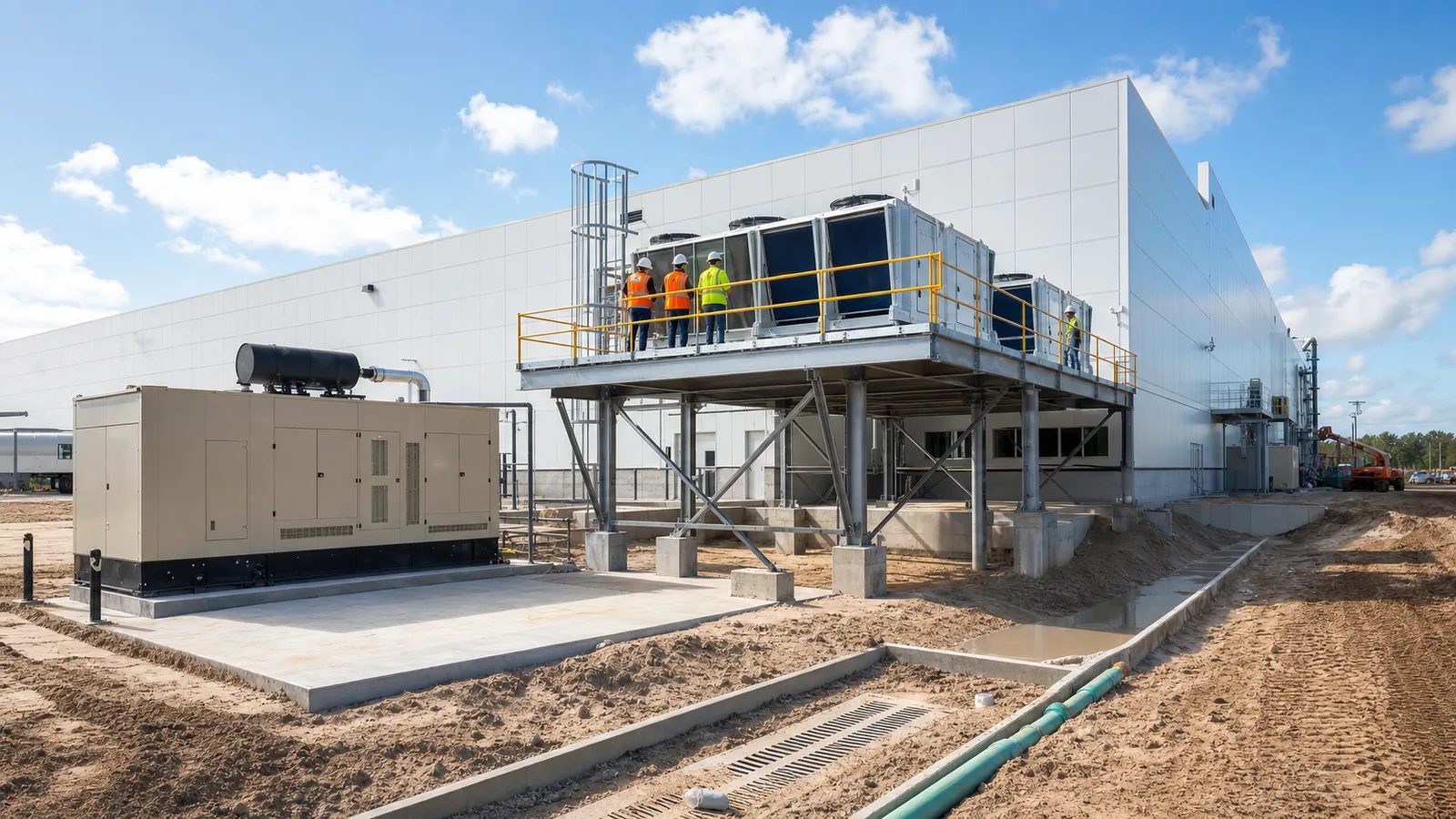
Cold storage facility resilience in Florida means building a facility that survives the events the state regularly delivers: flooding, power loss, and the wear of holding subfreezing temperatures for decades. A cold storage building represents a large investment protecting valuable, perishable product, and a single failure can mean total loss. This guide explains how flood design, backup power, freezer floor protection, equipment elevation, commissioning, and recovery planning combine to keep a Florida cold facility running when conditions turn against it.
Red Fox Construction brings 19 years of Florida commercial construction experience to cold storage projects across Central Florida, from Orlando to Tampa and surrounding areas. The resilience principles below draw on Florida flood provisions and recognized refrigerated facility and commissioning guidance so food, pharmaceutical, and logistics owners can build for the long haul.
What does resilience mean for a Florida cold storage facility?
Resilience means the facility can withstand floods and storms, keep refrigeration running through power disruptions, protect its freezer floor over decades, and recover quickly after an event. For cold storage, resilience is product protection. When the building holds up and the cold chain stays intact, the stored product survives, which is the entire point of the investment.
A cold storage facility is unlike most commercial buildings because its contents depend on continuous operation. A warehouse can sit dark for a day with little harm, but a freezer that loses refrigeration starts losing product within hours. Florida adds flooding, hurricanes, and grid disruptions to the picture, so resilience has to be designed in across the structure, the power systems, the floor, and the recovery plan.
Treating resilience as a design goal from the start, rather than a set of add-ons, produces a facility that protects product when it matters most. Owners planning a durable facility can review how Red Fox approaches cold storage construction with longevity in mind.
How do Florida flood rules shape a resilient cold storage design?
Florida flood rules shape resilient design by requiring buildings in flood hazard areas to resist flood loads, elevate critical equipment, and use flood damage resistant materials below the design flood elevation. Meeting these rules during design protects the refrigeration systems and structure that a cold facility cannot afford to lose in a flood.
The Florida flood resistant provisions guidance requires that new construction in flood hazard areas be designed and constructed to resist flood hazards and flood loads. Mechanical, electrical, and plumbing systems must be located at or above the elevation required for utilities and attendant equipment, with a narrow exception only for components specifically designed to resist flood loads. Exterior walls and interior finishes below the required elevation must use flood damage resistant materials.
For a cold storage facility, this guidance points directly at the systems that keep product cold. Refrigeration equipment, electrical gear, and controls are exactly the attendant equipment that must be elevated or protected. The guidance also requires site plans showing flood hazard areas and design flood elevations, and documentation sealed by a licensed professional. Building these requirements into the design protects the most critical systems, which Red Fox coordinates as part of its broader Florida commercial construction approach, led by Principal J.R. Horan.
Why is backup power critical for cold storage resilience?
Backup power is critical because a cold storage facility loses product within hours of a refrigeration shutdown, and Florida storms regularly knock out the grid. Standby generation keeps compressors, controls, and monitoring running through an outage. Without it, even a brief power loss during a hurricane can ruin an entire facility’s inventory.
Power continuity is the difference between an inconvenience and a catastrophe for cold storage. When the grid fails, the refrigeration that protects product fails with it unless backup power takes over. Florida’s hurricane season makes extended outages a realistic planning case, not a remote one. A resilient facility sizes standby generation to carry the refrigeration load, keeps fuel on hand, and protects the generator and switchgear from the same flood and wind hazards as the rest of the building.
Backup power also needs to be planned alongside flood elevation. There is little value in a generator that floods out in the storm it was meant to survive, so the Florida flood guidance on elevating equipment applies to standby systems too. Coordinating power resilience with the building design is part of how Red Fox plans cold facilities within its industrial construction work. Key resilience measures for a Florida cold facility include:
- Confirm flood hazard status and set floor and equipment elevations to meet the design flood elevation.
- Elevate or flood-protect refrigeration, electrical, and control equipment, including standby generation.
- Size backup power to carry the refrigeration load through realistic outage durations.
- Protect the freezer floor against frost heave with the appropriate underfloor system.
- Commission the refrigeration system thoroughly before the facility goes into service.
- Prepare a recovery plan so staff know how to respond after a storm or outage.
How does freezer floor design protect the facility for decades?
Freezer floor design protects the facility by preventing frost heave, the slow upheaval that occurs when subfreezing temperatures freeze moisture in the soil below. The ASHRAE guidance calls for a below-floor vapor retarder and underfloor heating in below-freezing facilities, because without it the subsoil freezes, moisture freezes, and the floor heaves and cracks.
Frost heave is a long-term failure mode unique to freezers, and it can destroy a floor that was otherwise sound. The ASHRAE refrigerated facility design guidance explains that facilities held above freezing need no special underfloor treatment, but below-freezing facilities need a below-floor vapor retarder, because without underfloor heating the subsoil eventually freezes, the moisture in it freezes, and the floor heaves. The preferred prevention methods are artificial heating through underfloor air ducts or glycol circulated through plastic pipe, with electric heating cables as another option.
The guidance adds practical detail that matters for decades of service. Air duct systems should be screened against rodents and sloped to drain condensation, and future expansion should be considered when designing the underfloor system. It also recommends heating the wearing slab under the dock in front of freezer doors to eliminate moisture at door and floor joints. Getting the freezer floor right at construction is far cheaper than fixing a heaved floor later, which is why Red Fox treats it as a core durability decision in its warehouse construction projects.
Why is commissioning essential to cold storage resilience?
Commissioning is essential because it verifies that the refrigeration system, controls, and energy performance actually work as designed before the facility goes into service. A commissioned system is more reliable and efficient, which means it is better prepared to handle stress. Starting up an unverified system risks discovering problems when product is already at risk.
Commissioning is the disciplined check that turns a built system into a trusted one. The ASHRAE refrigeration commissioning guide addresses heat loads, controls, energy modeling, and system performance for refrigeration. Verifying these before the facility holds product confirms the system can carry its design load, that controls respond correctly, and that the refrigeration operates efficiently. A facility that has been commissioned starts service with confidence rather than guesswork.
Resilience and efficiency go together here. A system tuned and verified through commissioning runs closer to its intended performance, which lowers energy cost during normal operation and leaves more margin during stress. Commissioning also produces documentation and a baseline that help staff recognize when something drifts later. Red Fox supports thorough commissioning as part of the handoff on its cold projects, and the Red Fox project team can coordinate the process with your refrigeration engineers.
What are the most common questions about cold storage facility resilience in Florida?
How quickly does cold storage product spoil after a power loss?
It depends on the product and the facility, but spoilage can begin within hours, especially for frozen goods that must stay well below freezing. A well-insulated room holds temperature longer than a poorly insulated one, yet no facility holds indefinitely. This is why backup power sized for the refrigeration load is a core resilience measure in Florida, where storm-related outages can last well beyond a few hours.
What is frost heave and why does it matter?
Frost heave is the upward movement of a freezer floor caused by moisture freezing in the soil beneath it. The ASHRAE guidance explains that without underfloor heating, the subsoil and its moisture freeze, and the floor heaves and can crack. Over years this can ruin the floor slab. Preventing it with a below-floor vapor retarder and underfloor heating during construction protects the facility for its full service life.
Does flood elevation apply to refrigeration equipment?
Yes. The Florida flood provisions require mechanical and electrical equipment in flood hazard areas to be located at or above the required elevation, with a narrow exception for components designed to resist flood loads. Refrigeration systems, electrical gear, and controls are exactly the attendant equipment this rule targets. Elevating or protecting them keeps the systems that maintain the cold chain from being knocked out by floodwater.
Is commissioning worth the added time and cost?
For cold storage, it generally is. Commissioning verifies that the refrigeration system, controls, and energy performance work as designed before product is at risk. The ASHRAE commissioning guide addresses heat loads, controls, and energy modeling for this reason. Catching a problem during commissioning is far less costly than discovering it after the facility is full of product, and a verified system tends to run more reliably and efficiently.
What belongs in a cold storage recovery plan?
A recovery plan should cover how staff respond to power loss, flooding, or storm damage, including switching to backup power, monitoring temperatures, protecting product, and restoring normal operation. It works best when it reflects the facility’s real systems and is practiced before it is needed. While construction provides the resilient building, the operating team’s plan determines how well the facility recovers when an event actually occurs.
Ready to build a resilient cold storage facility for Florida conditions?
Red Fox Construction brings 19 years of Florida commercial construction experience to cold storage projects across Central Florida, from Orlando to Tampa and surrounding areas. Led by Principal J.R. Horan and based in Casselberry, the team designs for flood exposure, power continuity, freezer floor durability, and thorough commissioning so a facility protects product for the long term.
One honest caution: resilience depends on coordination among the builder, the refrigeration engineer, and the operating team. Construction can deliver flood-resistant structure, elevated equipment, and a properly designed freezer floor, but backup power sizing and recovery planning require input from your engineers and operations staff. Bring those experts in early so the facility’s resilience is complete.
To start a cold storage conversation, call Red Fox at 407-755-9037 or reach the team through the Red Fox contact page. You can also learn more about Red Fox Construction and how the company approaches Florida cold storage work.