
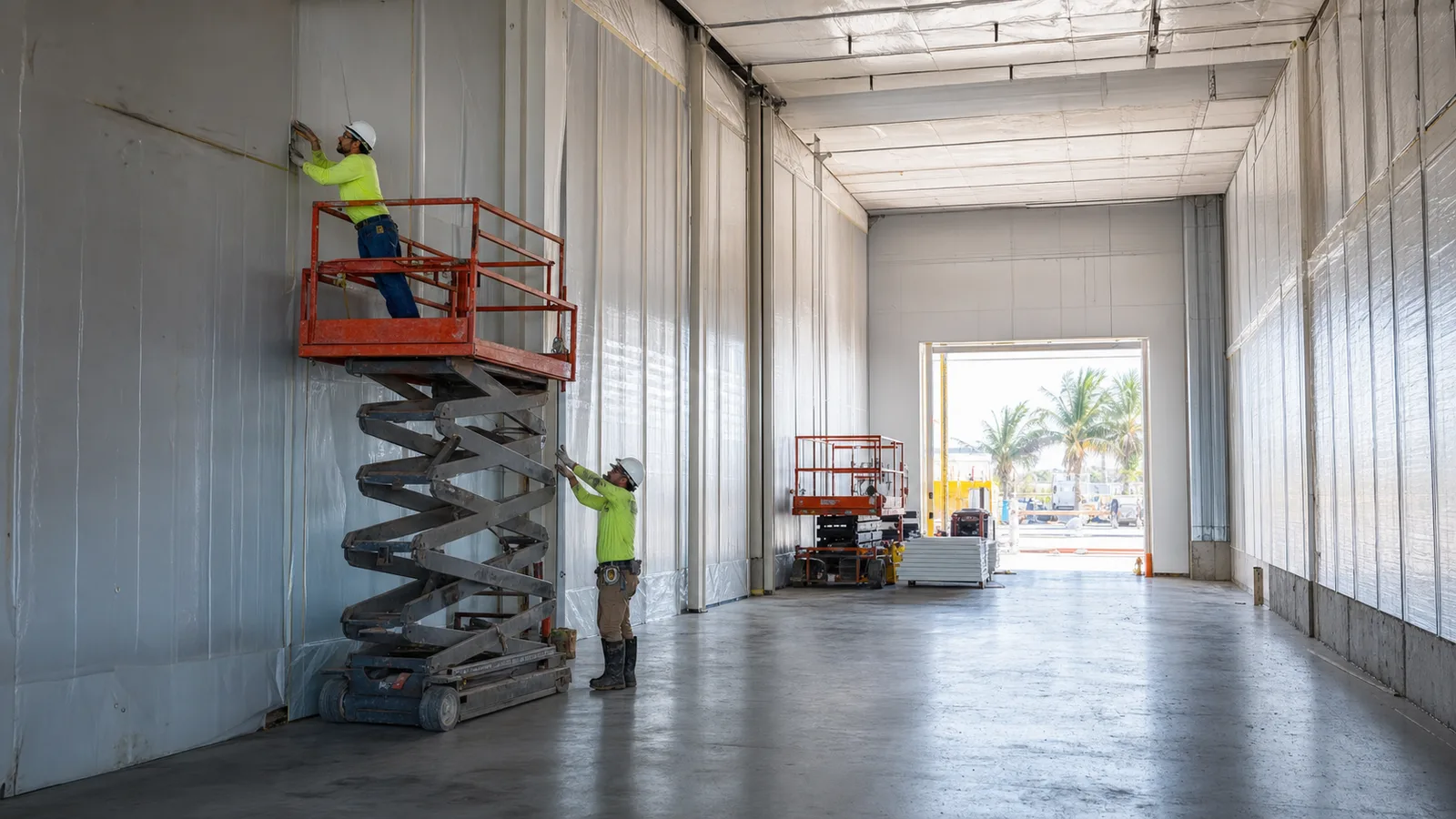
Cold storage construction in Florida humidity lives or dies on the building envelope. Florida air carries enormous moisture, and that moisture relentlessly seeks the cold interior of a cooler or freezer. If the vapor retarder, insulation, and detailing are not right, water vapor migrates into the walls and roof, condenses, freezes, and slowly destroys the building. This guide explains how vapor control, condensation prevention, and careful envelope detailing protect a Florida cold storage facility for the long term.
Red Fox Construction brings 19 years of Florida commercial construction experience to cold storage projects across Central Florida, from Orlando to Tampa and surrounding areas. The envelope principles below draw on recognized refrigerated facility design guidance so food, pharmaceutical, and logistics owners can build cold space that performs in one of the most demanding climates in the country.
Why is humidity the main enemy of Florida cold storage?
Humidity is the main enemy because warm, moist Florida air constantly pushes water vapor toward the cold interior, and any vapor that gets into the insulation condenses and freezes. That trapped moisture degrades insulation, corrodes structure, and causes frost damage. Controlling vapor at the envelope is the single most important factor in a durable Florida cold storage building.
The physics are simple and unforgiving. Water vapor moves from warm, humid air toward cold, dry space, and Florida supplies plenty of warm, humid air year round. When that vapor reaches cold insulation, it condenses, and in a freezer it freezes. Over time the insulation loses its value, the structure can corrode, and ice builds where it should never be. The damage is often invisible until it is severe, which is why prevention matters far more than repair.
This is why the envelope is the heart of a cold storage build, not an afterthought. Owners planning a new facility can review how Red Fox approaches cold storage construction and why envelope detailing receives so much attention.
How does a vapor retarder protect a cold storage envelope?
A vapor retarder protects the envelope by blocking water vapor from entering the insulation, and it must sit on the warm side of the insulation to work. Recognized refrigerated facility design guidance treats the vapor retarder as the primary concern in a low-temperature facility and calls for it to be as close to 100 percent effective as practical.
The ASHRAE refrigerated facility design guidance is direct about this: the vapor retarder system is the primary concern in a low-temperature facility, it should be nearly 100 percent effective, and it must be located on the warm side of the insulation. The success or failure of the entire insulation envelope depends on preventing vapor transmission into and through the insulation. A retarder on the wrong side, or one full of gaps, simply does not work.
The guidance also describes three ways to build an uninterrupted envelope: a total exterior vapor retarder and insulation system, an entirely interior system, or a combined interior and exterior approach. It states the total exterior system is best because it has the fewest penetrations and the lowest cost. Where temperatures vary widely between spaces, the guidance recommends dividing the building into separate envelopes to slow heat and moisture flow. These are design decisions that Red Fox coordinates as part of broader warehouse construction work.
Where does condensation form and how is it prevented?
Condensation forms where warm, moist air meets a cold surface, most often at wall and roof junctions, penetrations, and in interstitial spaces. It is prevented by sealing the envelope tightly, ventilating concealed spaces, and keeping surfaces above the dew point. The ASHRAE guidance identifies air and vapor leakage at wall and roof junctions as perhaps the predominant construction problem in cold storage.
Condensation is the visible symptom of a vapor control failure, and it shows up in predictable places. The ASHRAE guidance points to air and vapor leakage at wall and roof junctions as the leading construction problem, and recommends an air and vapor flashing sheet system to prevent it. Inside a cooler, condensation on surfaces is unacceptable because a wet surface becomes a culture base for bacteria and dripping can condemn product.
For concealed spaces above ceilings, the guidance describes the most common prevention method as continuously ventilating outdoor air into the interstitial space, with a sealed-and-dehumidified approach as an alternative. Ceiling plenums are best ventilated by mechanical vents that move air above the envelope. Penetrations need special attention. The guidance calls for sealing and insulating beams, columns, and large pipes that pass through the envelope, and for insulating small pipes and conduit at greater thickness around the penetration. Getting these details right is where experienced field supervision earns its keep, which the Red Fox project team brings to every cold build.
What insulation levels does a Florida cold facility need?
A Florida cold facility needs insulation matched to the storage temperature, with higher values for freezers than for coolers. The ASHRAE guidance distinguishes coolers, which usually operate above 0 degrees Celsius, from low-temperature freezers below 0, and it provides recommended insulation ranges that rise as the target temperature drops.
Insulation is sized to the job. The ASHRAE guidance separates refrigerated storage into categories, from coolers at 0 degrees Celsius and above to low-temperature rooms generally held at minus 20 to minus 29 degrees Celsius, with blast freezers colder still. It then gives recommended insulation R-values that climb as temperatures fall, with freezers requiring substantially more wall, ceiling, and floor insulation than coolers. The colder the space, the larger the temperature difference the envelope must hold against Florida heat.
The guidance offers a practical planning tip: if a cooler might be converted to a freezer in the future, consider insulating it to freezer values from the start. That foresight avoids a costly tear-out later. Matching insulation to current and likely future use is part of how Red Fox plans durable cold space within its overall Florida commercial construction approach, led by Principal J.R. Horan. Key envelope priorities for a Florida cold build include:
- Select insulation R-values matched to each room’s storage temperature, not a single building average.
- Place the vapor retarder on the warm side and aim for a near-continuous, fully sealed envelope.
- Detail wall and roof junctions with a flashing sheet system to stop air and vapor leakage.
- Seal and insulate every structural penetration so it does not break the vapor barrier.
- Ventilate or dehumidify interstitial spaces to keep concealed surfaces above the dew point.
How does airflow design affect moisture and product quality?
Airflow design affects moisture because poor air distribution creates stagnant zones, hot spots, and frost on cooling coils. The ASHRAE guidance stresses considering the distance air must travel, called throw, so that even the farthest area is cooled. Good airflow keeps temperatures uniform and limits the moisture problems that come with stagnant, humid pockets.
Air movement is part of moisture control, not separate from it. The ASHRAE guidance explains that fan-coil selection must account for throw, the distance air must travel to cool the farthest area, and that failing to consider throw and unit location can leave areas of stagnant air and hot spots. Those stagnant zones are where temperature drifts and condensation risk rises, which threatens stored product.
Frost on the cooling coils is another airflow concern. The guidance notes that units operating below roughly 3.3 degrees Celsius require defrosting, and that units placed above entrances tend to draw in warm, moist air and frost quickly, sometimes clogging the coil rapidly. Thoughtful placement of cooling units, away from doors and sized for the room’s throw, keeps both the air and the product in good condition. These choices connect envelope design to mechanical design, and Red Fox coordinates both in its industrial construction projects.
What are the most common questions about cold storage construction in Florida humidity?
Why does the vapor retarder go on the warm side?
It goes on the warm side because vapor moves from warm to cold, so the barrier must stop that vapor before it enters the insulation. The ASHRAE guidance is explicit that the vapor retarder must be located on the warm side of the insulation. Placing it on the cold side would let vapor pass into the insulation and condense there, which is exactly the failure the retarder is meant to prevent.
What happens if moisture gets into the insulation?
Moisture in the insulation reduces its thermal value, so the refrigeration system works harder and energy costs rise. In a freezer the trapped moisture freezes, expands, and can damage the insulation and structure over time. The damage often hides inside the envelope until it becomes severe. This is why a near-continuous vapor retarder and sealed penetrations matter so much in a humid climate like Florida.
Can a cooler be converted to a freezer later?
It can, but it is far easier if the building is designed for it from the start. The ASHRAE guidance suggests that where a cooler may later become a freezer, owners should consider insulating to the higher freezer R-values up front. Converting an under-insulated cooler to a freezer afterward usually means significant insulation and envelope work, so planning for the possibility early saves money.
Why is condensation worse at wall and roof junctions?
Those junctions are where two assemblies meet, which makes them the hardest places to keep the vapor retarder continuous. The ASHRAE guidance identifies air and vapor leakage at wall and roof junctions as perhaps the predominant construction problem in cold storage, and recommends a flashing sheet system to address it. Any gap there lets humid air reach cold surfaces, where it condenses and can lead to ongoing moisture damage.
How does Florida humidity change cold storage design versus a drier state?
Florida’s high humidity raises the vapor pressure pushing into the building year round, so the envelope must be more carefully sealed and the vapor retarder more complete than in a dry climate. The same temperature difference moves more moisture when the outside air is humid. Refrigerated docks and condensation control also become more important, because warm, humid air carries far more water than cooler, drier air.
Ready to build durable cold storage for the Florida climate?
Red Fox Construction brings 19 years of Florida commercial construction experience to cold storage projects across Central Florida, from Orlando to Tampa and surrounding areas. Led by Principal J.R. Horan and based in Casselberry, the team treats the vapor retarder and envelope detailing as the foundation of a cold facility that performs in Florida humidity.
One honest caution: envelope performance depends on close coordination among the general, roofing, and insulation contractors, and on careful field workmanship. The ASHRAE guidance notes that close cooperation among trades increases the likelihood of a successful installation. Even a strong design can fail if the field work is rushed, so plan for experienced supervision.
To start a cold storage conversation, call Red Fox at 407-755-9037 or reach the team through the Red Fox contact page. You can also learn more about Red Fox Construction and how the company approaches Florida cold storage work.