
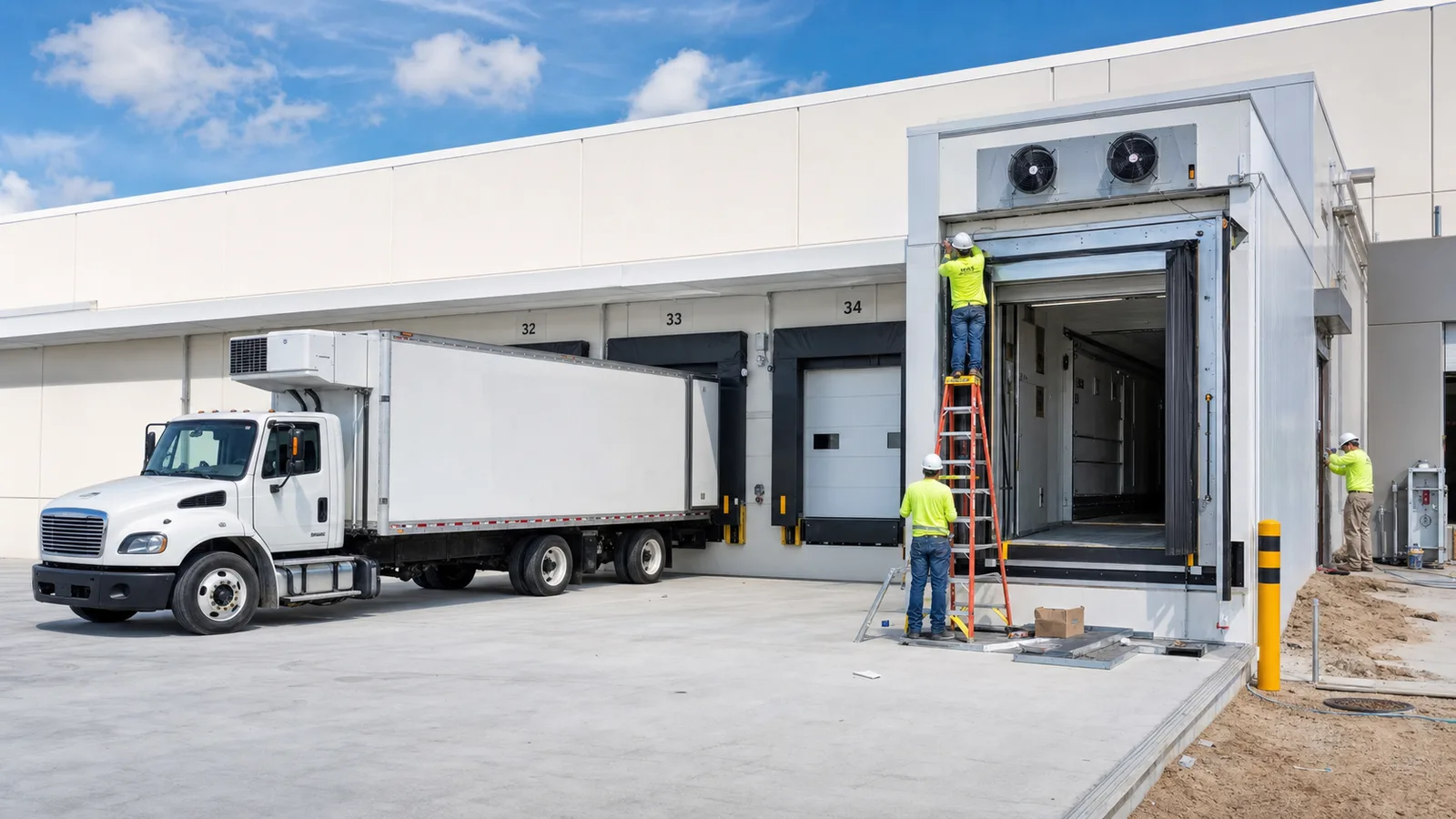
Cold storage loading dock design in Florida is where the cold chain is most exposed. Every time a door opens to the warm, humid outdoors, the facility fights to hold temperature, and product sits at its most vulnerable. A well-designed refrigerated dock with proper door seals, smart traffic patterns, and clean food distribution handoffs protects both product quality and energy cost. This guide explains how to design a Florida cold storage dock that keeps the cold chain intact from truck to freezer.
Red Fox Construction brings 19 years of Florida commercial construction experience to cold storage projects across Central Florida, from Orlando to Tampa and surrounding areas. The dock design principles below draw on recognized refrigerated facility guidance and federal food transport rules so food and logistics owners can build docks that perform in a demanding climate.
Why is the loading dock the weak point in a cold storage facility?
The loading dock is the weak point because it is where conditioned interior air meets warm, humid outdoor air every time a door opens. That exchange drives up refrigeration load, invites condensation and frost, and exposes product to temperature swings. In Florida’s climate, an undersized or poorly sealed dock undermines the entire facility’s performance.
The dock is the one place where the building must regularly open to the outside, and in Florida that outside air is hot and heavy with moisture. Each door opening lets warm, humid air rush in toward the cold space, raising the refrigeration load and seeding frost and condensation near the openings. Product moving across the dock spends time outside the protection of the storage room, so the longer and warmer that transfer, the more quality is at risk.
Designing the dock to limit that exchange is one of the highest-value decisions in a cold storage project. Owners planning a distribution facility can review how Red Fox approaches cold storage construction and why the dock receives so much design attention.
Why refrigerate the loading dock in Florida?
Refrigerating the dock is essential in Florida because a cooled anteroom reduces the shock between outdoor air and the storage rooms. The ASHRAE guidance states that dock refrigeration is an absolute necessity in humid and warm climates and that holding the dock around 1 to 7 degrees Celsius cuts refrigeration load and frost in the storage area.
The ASHRAE refrigerated facility design guidance is unambiguous: dock refrigeration is an absolute necessity in humid and warm climates, which describes Florida exactly. By turning the dock into a refrigerated anteroom held at roughly 1 to 7 degrees Celsius, the facility gains several advantages at once. The guidance lists them: reduced refrigeration load in the low-temperature storage, less ice and frost because less humid air infiltrates, better product temperature on the dock, drier packaging, more comfortable staff, and less equipment maintenance because condensation drops.
A refrigerated dock also keeps floors drier, particularly in front of freezer doors, which improves housekeeping and safety. The guidance even notes that a refrigerated dock can reduce or eliminate the need for separate anterooms or vestibules to the freezer. For a Florida facility, the refrigerated dock is not an upgrade to consider later. It is a core part of the design, and Red Fox treats it that way across its warehouse construction work.
How do door seals and dock equipment control infiltration?
Door seals and dock equipment control infiltration by closing the gap between the truck and the building so warm air cannot pour in around the trailer. The ASHRAE guidance points to cushion-closure seals around truck doorways as a way to reduce outdoor air infiltration, and to insulated dock doors mounted on the indoor side of walls.
The seal between trailer and building is where most uncontrolled air exchange happens, and the right equipment closes that gap. The ASHRAE guidance calls for cushion-closure seals around truck doorways to cut infiltration of outdoor air, and lists seal-cushion closures on doors as an essential item in a one-story refrigerated layout. It also specifies that insulated dock doors must be mounted on the indoor side of walls, which keeps the door within the conditioned envelope.
How well these features perform depends heavily on operations. The guidance notes that dock load depends on the efficiency of truck dock door seals and on the diligence of staff to promptly close doors when trucks are not loading or unloading. It also lists batten doors or strip curtains as part of a refrigerated layout. The right combination of seals, fast-acting doors, and disciplined door management keeps infiltration low. Red Fox helps owners specify this equipment as part of its industrial construction approach.
How should traffic patterns and dock space be planned?
Traffic patterns and dock space should be planned so goods move quickly from truck to storage without congestion or backtracking. The ASHRAE guidance recommends generous space for moving goods, storing pallets and idle equipment, sorting, and inspecting, and states the dock should be at least 9 meters wide. Smooth flow shortens the time product spends exposed.
A dock that is too tight or poorly organized slows everything down, and on a cold dock, time is temperature. The ASHRAE guidance calls for liberal space for the movement of goods to and from storage, for staging pallets and idle equipment, and for sorting and inspecting, and it sets a minimum dock width of about 9 meters. Enough room means product does not pile up waiting to move, and forklifts do not cross paths in ways that cause delays or hazards. Plan the dock around clear flow:
- Provide at least the recommended dock width so goods, pallets, and equipment are not crowded.
- Separate inbound and outbound flow where possible to avoid cross traffic and confusion.
- Locate staging, sorting, and inspection areas so product moves forward, not back and forth.
- Position dock doors and storage entrances to create short, direct paths into the cold rooms.
- Keep aisles clear of idle equipment with designated parking and charging areas.
Designing the dock around how product actually moves keeps the cold chain fast and the floor safe, which is part of how Red Fox plans cold facilities within its Florida commercial construction approach, led by Principal J.R. Horan.
How does food distribution handoff affect dock design?
Food distribution handoff affects dock design because the dock is where responsibility for temperature and sanitation passes between the facility and the carrier. Federal rules require transport equipment capable of maintaining necessary temperatures and adequate temperature controls during transit, so the dock must support a clean, monitored transfer to and from refrigerated trucks.
The handoff between warehouse and truck is a regulated moment. The FDA sanitary transportation rule requires that vehicles and transportation equipment be suitable, adequately cleanable, and capable of maintaining the temperatures necessary for safe food transport, and that operations include adequate temperature controls and protection from contamination. The dock is where product crosses that boundary, so its design should support pre-cooled trailers, monitored transfers, and sanitary conditions.
The rule also addresses training and records, requiring that carrier personnel be trained in sanitary transportation practices with documentation, and that records be kept. A dock designed for the cold chain makes compliance easier by keeping product cold during transfer, providing space for inspection, and supporting the temperature monitoring that distribution requires. Red Fox coordinates these distribution realities with owners during design, and the Red Fox project team can review handoff requirements with your operations staff.
What are the most common questions about cold storage loading dock design in Florida?
What temperature should a refrigerated dock be held at?
The ASHRAE guidance recommends holding a refrigerated dock at roughly 1 to 7 degrees Celsius. That range keeps the dock cool enough to reduce the refrigeration load on the storage rooms and limit frost, while remaining workable for staff. The exact setpoint depends on the products handled and the temperatures of the connecting rooms, but a dock in that range provides the buffer a Florida facility needs against hot, humid outdoor air.
Why mount dock doors on the inside of the wall?
The ASHRAE guidance specifies that insulated dock doors be mounted on the indoor side of walls. Mounting the door inside keeps it within the conditioned space and helps maintain a continuous insulated envelope. It also protects the door hardware from the worst of the outdoor heat and moisture. This detail supports both the thermal performance of the dock and the durability of the door equipment over time.
Do door seals alone keep the dock cold?
No. Seals reduce infiltration when a trailer is docked, but the ASHRAE guidance also points to staff diligence in closing doors promptly when trucks are not loading or unloading. Seals, fast-acting doors, and strip curtains all help, yet open doors with no truck in place still let warm air flood in. Equipment and operations work together, so design and daily discipline both matter for holding dock temperature.
How wide should a cold storage dock be?
The ASHRAE guidance sets a minimum dock width of about 9 meters and calls for generous space to move goods, stage pallets, store idle equipment, and inspect product. A wider dock reduces congestion, speeds product flow, and improves safety. The right width for a specific facility depends on throughput and equipment, but the minimum gives a useful starting point for planning a dock that does not bottleneck the cold chain.
What does the FDA sanitary transportation rule require at the dock?
The rule does not dictate dock construction, but it requires that transport equipment be cleanable and capable of maintaining necessary temperatures, with adequate temperature controls and protection from contamination during transit. At the dock, that translates into supporting pre-cooled trailers, monitored transfers, sanitary conditions, and the training and records the rule expects. A well-designed dock makes meeting these requirements easier by keeping product cold through the handoff.
Ready to design a cold storage dock that holds the cold chain in Florida?
Red Fox Construction brings 19 years of Florida commercial construction experience to cold storage projects across Central Florida, from Orlando to Tampa and surrounding areas. Led by Principal J.R. Horan and based in Casselberry, the team designs refrigerated docks with the seals, doors, space, and flow that a Florida facility needs to protect product and energy.
One honest caution: even the best dock design depends on day-to-day operations to perform. The ASHRAE guidance ties dock load to how diligently staff close doors when trucks are not present. A facility should pair good dock construction with clear operating practices, because hardware alone cannot hold temperature if doors stay open.
To start a cold storage conversation, call Red Fox at 407-755-9037 or reach the team through the Red Fox contact page. You can also learn more about Red Fox Construction and how the company approaches Florida cold storage work.